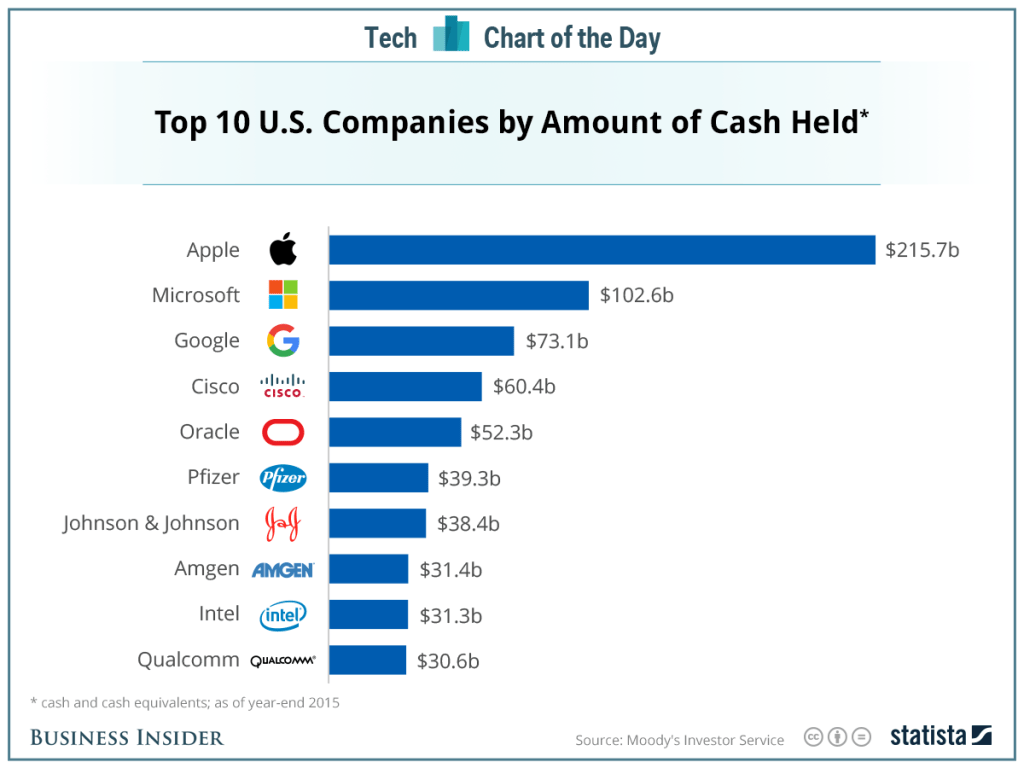
• World has seen wealth inequality and income inequality spike. It is not the result of poor economics or poor policy decisions. It is a result of poor distribution of wealth generated by our corporations. You may name them public corporations but the significant pie of it stays with private hands and promoters. It is a result of ownership claim and reward which the entrepreneur receives for his initiative and hard work. Many billionaires have been minted by this basis, namely, Bill Gates, Jeff Bezos, Jack Ma and many more names. Nobody could have imagined different ideas and their execution could make them own as much as bottom 50% of the American population. Every two days one billionaire is created in today’s technology driven world. According to MarketWatch, richest 10% households in the US hold 73% wealth of the country. In India, the case is even worse, according to Business Insider, top 1% of India alone holds 73% of wealth of the country. This high skewness comes from the fact that entrepreneurs may have been overly rewarded for their initiative and business skills. Entrepreneurs are important to make economic leaps but it by no means translates into meaning that they have to be overly rewarded for their risk taking behaviour. In fact, they can’t take off without their dutiful employees, suppliers, customers and society who are willing to purchase their ideas and execution.

    1. Change the distribution of equity

    Let’s say the distribution of equity should be changed. No investor or entrepreneur should hold more than a fixed percentage of company. It could be based on market cap or some other relevant measure. Employees and suppliers could be more rewarded. Equity could be allocated more than today’s standards to these groups. This way wealth distribution from a successful venture becomes more equitable and just. After all, these employees have also contributed to the success of the company. This will produce more millionaires, more consumption and more innovation as the successful venture could lead to more entrepreneurs being born from it. PayPal is a great example. PayPal’s own value may not be high compared to tech giants but it has given birth to many multi billion dollar companies due to its employees’ entrepreneurial initiatives. The founders can be given differential voting rights to address their concerns related to management.

    2. Change laws

    Change laws to regulate the percentage of wealth the top households can hold at a given point in time. This way they will be fairly rewarded and also won’t lead to high concentration of wealth with a specific group. This way they will have to give away wealth which could be transferred to have nots or government and then they can use to fund their economic objectives. This has become necessary because today even higher skills don’t transform into high wealth. People may be living a high quality of life but they may not be able to accumulate wealth at a pace which matches the top 1%. This is because top 1% own top companies which yield top value creation businesses. This can be seen as Amazon, Google, Apple and other big tech names have started entering into different diverse areas of business which are not necessarily their line of business. For example, Amazon is now collecting retail data on its website to produce consumer products under their brand Amazon basics taking away share from smaller companies which can’t compete on quality and brand. All of this market power is leading to anti trust laws being used in the US to breakup these companies.

    3. Teach money management

    Schools only teach you how to get a job by leveraging your skills and building resume but getting rich is not a function of your skills. It’s a function of how well you manage your money. Teaching the kids the ideas about wealth and money management can help them start early in their careers and weigh their uses of money much better. Money management can become a mandatory subject for students so that they make more informed choices about how to manage money even before they pass out school or college. This way wealth distribution can be addressed. Rich people may not know the scientific process behind their company’s production process but they very well know how to deploy the capital that they have.

    4. Use more labour intensive techniques

    Adopting artificial intelligence maybe a mistake in part of global economies right now. If one nation adopts AI in a better way than the other country and with free trade we could face social issues. Developing countries could simply become unemployed because the developed nations adopt AI. AI is still at a nascent stage. With the current population in developing nations globally still living below poverty line, adopting AI will be a fatal mistake for these nations. Plus the technological advancement with AI could make developed nations even more powerful and wealthy. AI needs a population which has high end technical skills so that they remain employed and do meaningful work. Right now, developing nations need to first adopt and go through industrial revolutions of previous ages to build an environment which can include AI. With free trade and such big technological differences it will become a daunting task to uplift people living in poverty. A global framework to regulate and monitor development and implementation of AI could help nations build better economies in respect to current technologies. The best way right now to uplift millions of people from poverty is labour intensive methods of production. It could be wrong, AI maybe able to help solve problems like education and health but till the time we don’t discover such solutions it remains in our best interests to protect the people by making it mandatory for countries to use labour intensive method of production and regulating free trade in case other developed nations start using AI at a large scale.

    Conclusion

    Capitalism has been the best mode to grow an economy. It will continue to remain so. Wealth inequality is the symptom of capitalism done wrong. It doesn’t mean that capitalism is the wrong way. It needs tweaks so that the pie becomes more equitable and just. Innovation, reward and risk still remain the best motivators for people to startup their own ventures. Capitalism needs to be reworked, whether one likes it or not but capitalism still remains the best way to move people out of poverty.

  • What a week ! Finance minister Nirmala Sitharaman undertook a very bold reform to boost the economy and also provide a long term structural change which will change the trajectory and put it on high gear for the overall economy. Finally, Indian corporates got their duly deserved tax break that they have been wishing for. India lowered the corporate taxes rate (22% without exemptions)in a blockbuster move on Friday. It definitely went a long way to appease the investors.The market zoomed up by more than 5%, single biggest gains in a day in years! What was more extraordinary about the announcement is the focus on manufacturing sector. India lowered the tax rate on manufacturing units to 15% for units incorporated on or after October 1st, 2019 and initiating operations before 31st March, 2023. So why is all of this important?

    1.First of all, FDI

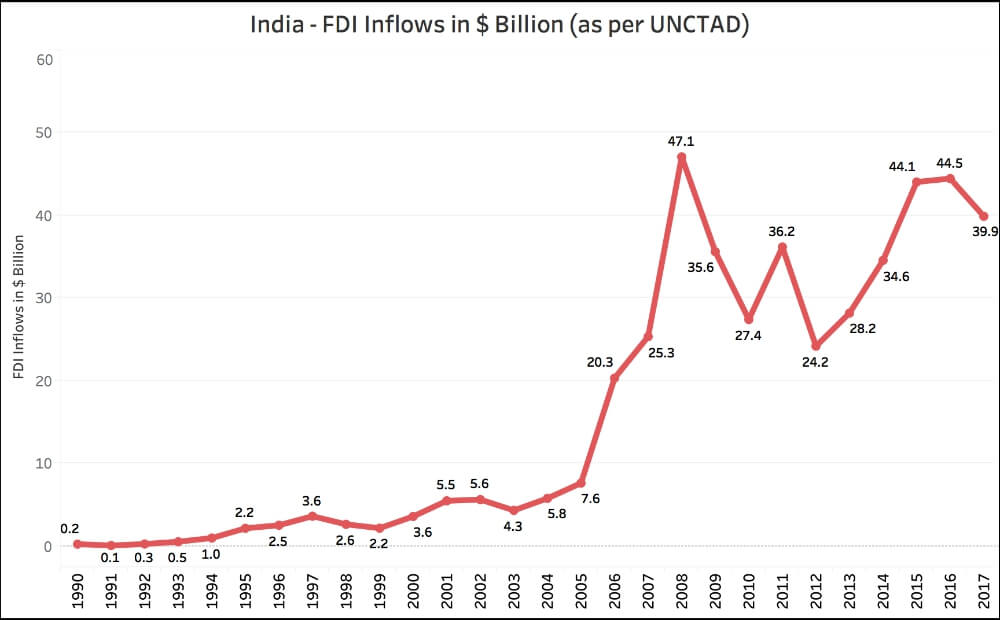
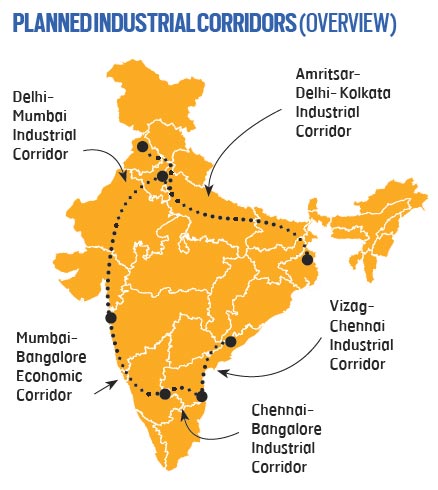
    This goes without saying that India is truly inviting global companies to come and set up shop in the country. Reaching the goal of manufacturing contribution of 25% in GDP in 2025 seems realistic now. This part is really important to address the job problem. Foreign direct investment is a very crucial component for any country. It is a testament to the country’s superiority in economic front. China witnessed astounding growth rates due to FDI. They received so much capital which help kick up start an economic revolution. Now China is under the focus of a President who doesn’t care about anything but America. Beijing may find it tough to crack a deal without comprising on some crucial aspects. The scenario has sweetened up for India. Although, trade war was waging, India wasn’t benefitting. Companies went to its neighbours and other countries globally. This can change now. With India willing to offer concession in taxes and preparing a mega infrastructural push, this opportunity is big. It is big because groundwork is being laid for a mega transformation which could put India on map for global supply chains. A 100 lakh crore rupees infrastructural investment in next 5 years, coupled with low manufacturing corporate tax of 15%, effectively 17%, presents an opportunity to diversify supply chains. Government didn’t have to sacrifice on revenue fronts as well because this tax rate is valid for future manufacturing companies.

    2. Deficit increase?Not to worry

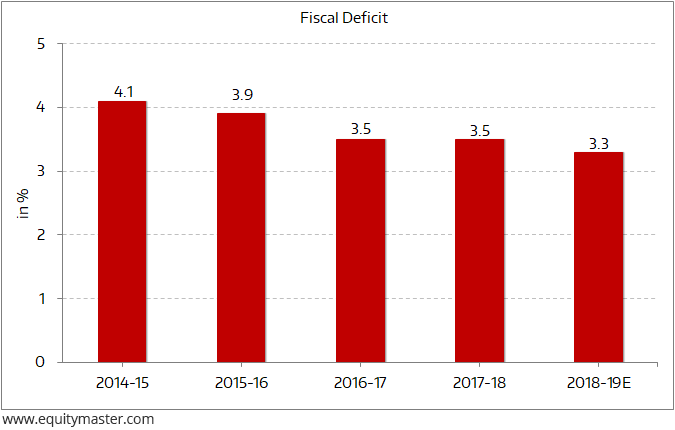
    There is a lot of concern surrounding the deficit that the tax cut will create. 1.45 lakh crore rupees of revenue will be forgone in undertaking these tax cuts. This can increase fiscal deficit to 4% of GDP. Increase in fiscal deficit will fuel inflation and increase government obligations. All of that is true but at the same time, you get an increase in savings by 1.45 lakh crore. These savings will transmit in the form of capital investment, price cuts and increase in other activities. This will fuel the economy. There will be lag ,of course. There couldn’t have been a better time to undertake these reforms. Interest rates are falling globally, investment and spending is falling and other slowdown signs are visible. It will be a great chance to further open up financial markets as India needs a lot of capital now. FDI alone won’t fulfil the demand. Current crowding out of funds can only be addressed by integrating India more with global financial markets. Another concern is the infrastructure spending which the government plans to undertake. Total outlay is 100 lakh crore for 5 years which works out to 20 lakh crore per year. So based on current estimates India will have to spend 10.5% of GDP on infrastructure alone which shall start falling year by year as GDP size increases. Government will have to make it easier for private players, including foreign entities, to help build infrastructure in India. That will require lot of capital and India alone can’t provide that amount of capital. Off balance sheet liabilities also are a cause of concern. Revenue shortfall may not be fully met from increased economic activity but a fair amount of increased economic activity could help reduce the fiscal deficit. However, these measures suggest that the attitude of the government is pro growth.

    Note: This is a graph for FY19

    3. Confidence is the key

    It is always argued what causes recessions or global financial meltdowns? Is it debt? Is it structural shift in the economy? One thing always comes out is that the human optimism and pessimism are the key in turning economy. Since last three quarters, investors and businessmen turned pessimistic which aided in the fall of the growth rate. Now with such confidence boosting measures we will see a shift in the attitude from pessimism to optimism. What remains to be seen is that the government will have to deliver on the promises on FDI fronts and create jobs. It can only happen with the measures India is taking now. If FDI flow increases, there will be a natural phenomenon of increased confidence in the state of the economy. Infrastructure push remains absolutely important. This will in turn benefit in improving the growth rate. Plus, improving the way tax collections is done and bringing more transparency will help. Savings may remain a problem for sometime until incomes rise and compensate for the lost savings in last few years. Consumerism is on rise but importantly if India receives FDI, lot of high quality jobs can be created.

    Conclusion

    Global message has been sent. India is ready to undertake its transformation. Realising a $5 trillion dollar economy is not a dream anymore. It’s a commitment India is willing to make. India is pro growth and investor friendly. All India needs now is capital and risk taking. It is a huge gamble which the government has undertaken and its a good one. Opening up markets further, helping reduce tax burden, making procedures simple and building infrastructure is the need of the hour. Its the leap of faith now companies have to make.

  • India, the rise of a new Asian giant, China vs India and what not, all these types of stories are doing the rounds everywhere globally, so much so, that the US renamed its US Pacific command as US Indo-Pacific command in recognition of the Indian sub continent. India has been growing so fast, that it has been named the fastest growing major economy. There is no doubt about the name given to it and it is true. The next billion consumers live in India and their aspirations are growing. 45% of the population is below the age of 25. No economy can be better placed than this, then why is it that we are facing a slowdown? Yes we are having a global slowdown in consumption and investment but India’s domestic story is well placed and can easily address these issues for global investors. The sentiment has turned so negative that including a 20% growth rate in our investment analysis would be foolish. The funding crunch is not alone to blame, you have many internal structural problems in the economy and that is the reason we are facing a slowdown. Every credit cycle slows down at some point and it happened with IL&FS going down, then DHFL and turn by turn many more companies reported shortage of credit. So what are the possible routes for the economy and government? This article deals with a long term perspective rather than short term measures which are addressed to boost sentiment.

    1.Change in philosophy

    The solutions tend to be innovative when we start thinking from a changed perspective. If the question changes from ‘How do we address the slowdown’ to ‘How do we uplift the next 100 million people out of poverty’ or ‘How do we make India on par with other developed nations’ the answers to the questions change automatically. Growth can be achieved in multiple ways, one way is of course, capital, it’s easy to spend as much as possible to boost the economic numbers but that growth usually won’t sustain for long. After all you gotta keep your Balance Sheet intact and managing risks at the same time. Second way is undertaking reforms and making radical changes which address long term problems of the businesses. You can’t keep relying on fiscal math to do you favours. Eventually that source of money will burn up and when the economic gloom hits you don’t really have any sources to boost growth and that makes it worse. To do this, of course, you gotta have a change of attitude and approach with modern solutions. If growth rate has to increase, we have to allow businesses to make decisions in much quicker ways. Bureaucrats, policy makers and everybody else in the government have to look at issues with a fundamental eye. Zoning laws for cities to manage the city infrastructure, controlling population, etc are the basic elements which will address issues at micro level. If you have a well planned city which is efficient, it can address problems like transportation which could indirectly lead to capital formation. You get a cheap and efficient transportation system, you will save more time and money thus increasing productivity at the same time.

    2. Let’s talk services

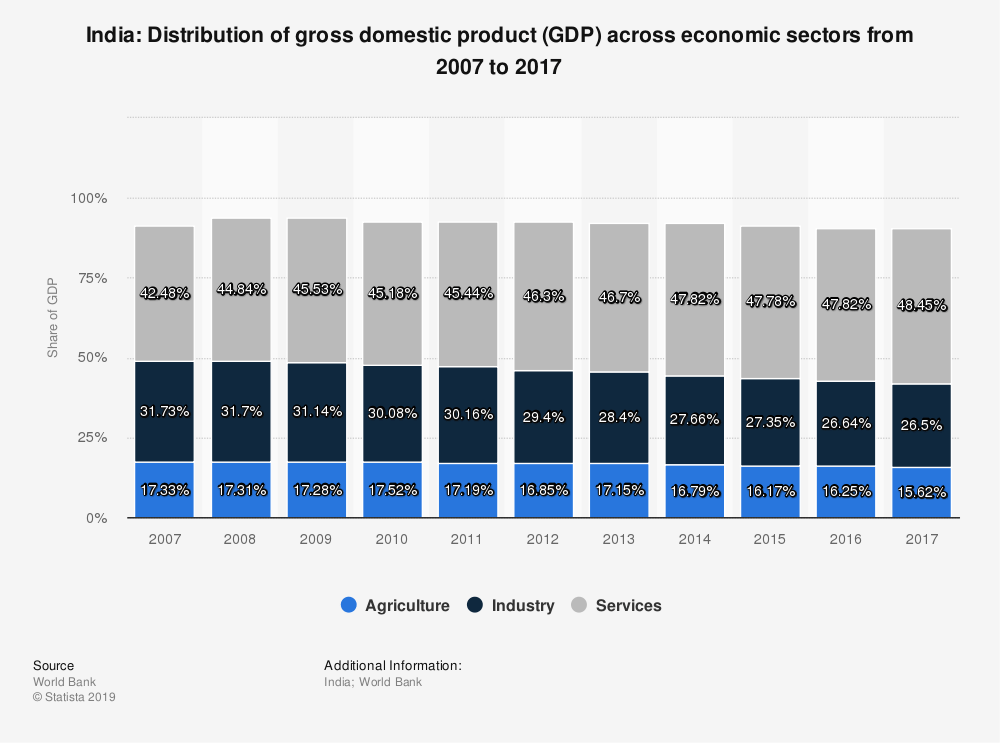
    India’s highest GDP contributor is services, with a contribution of more than 50%. India’s strength is services. If we rely more on services export we would be better off. India has already skipped the process of industrialisation and going back to manufacturing with no infrastructure to support it would be even tougher. Meanwhile, we have an internet boom going on in India where we have people accessing the internet for the first time from their smartphones. The infrastructure is ready made for accessing the internet. New age technologies permit entrepreneurs and employees to work from their homes or off shore. Services led growth presents a big opportunity for the Indian economy. If services keep growing, automatically there will be demand for manufacturing. We have a population more than willing to work in services sector and is well equipped to lead its growth. Starting services units is easier than manufacturing units which require several clearances from authorities, meet pollution norms, etc. This makes the process complicated from start to end delaying the ability to take advantage of global trends. Plus being a capital starved nation with so many risks, services provides a bigger advantage. Indian exports have been subdued in the past five years. We broke the 2014 high of $314 billion in 2019 with $331 billion. Meanwhile, our imports also rose to an astounding $507 billion, however, there was pressure even in oil markets which added to the steep import bill. India still remains strategically vulnerable due to its structural problems. With added anxiety in global markets, growth from exports will remain challenging. Bangladesh and Vietnam also stand as tough competitors to Indian exporters.

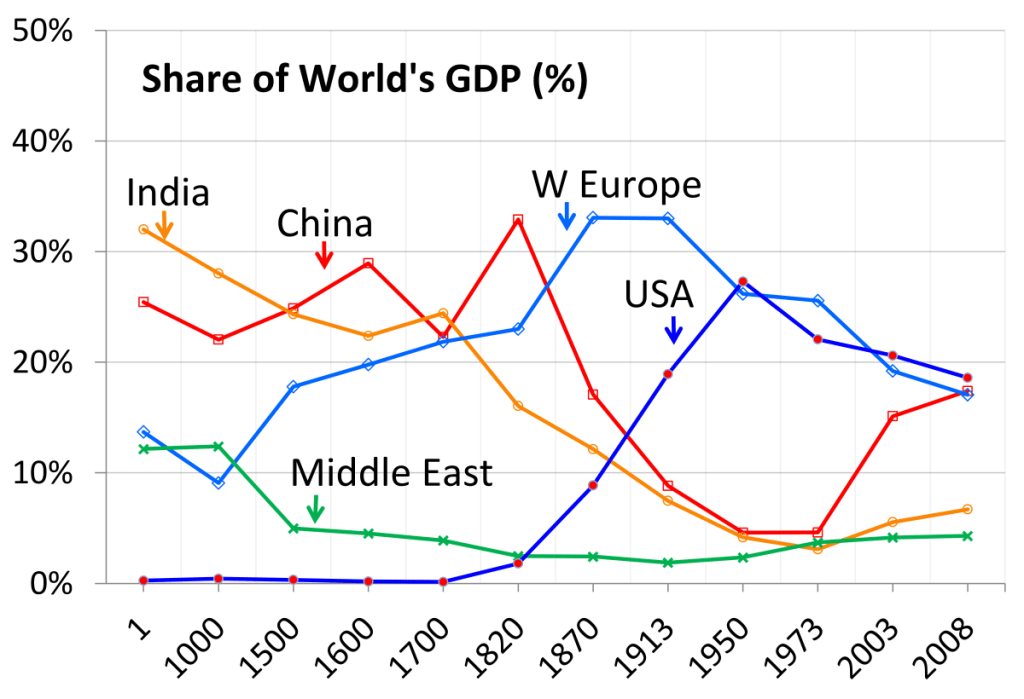
    This chart depicts the importance of adoption of technology, innovation and military. World war, trade and adoption of technologies greatly changed the dynamics of the world. Countries which maintained high quality military continued to remain safe and dominate the world.

    3. Adoption of new age technologies

    The faster you adopt, the better it is and it goes without saying that AI, machine learning, drones, self driving vehicles, electric vehicles, space technology, etc are going to play a central role in the development of economies in the future. We already have American private technology companies like SpaceX and Blue origin who are working on reaching Mars and undertaking risky missions and proving their technological prowess. We need indigenous companies working on futuristic consumer technologies rather than accepting their products. Technology is a big competitive advantage and it can be seen from the exports of nations like Russia, the US, China, South Korea, Japan, etc. Every highly successful nation offers products which the domestic economies of other nations aren’t able to produce which creates a differentiator and becomes a foreign exchange earner. Relying on traditional industries like mining, cement, electricity, etc was a thing of the past. Kickstarting modern consumer technologies can possibly not only boost GDP but offer a distinct competitive advantage. Every country has basic demand but differentiator lies in how we meet the needs. India lost out smartphone race because domestic companies like Lava, Karboon and Micromax chased numbers rather than addressing research and development. Meanwhile Chinese companies, who command more than 70% of the market share, were busy building supply chains and competencies to deliver future returns. Boeing (US)and Airbus ( France) rule the aviation industry. Aviation today is a basic requirement and these countries fulfil the needs in safest and cheapest ways thus gaining a natural advantage and became one of their most important exported product.

    Just some global US companies present in strategic industries. Note this chart is outdated and is only used for presentation purposes.

    4. Address basic issues first

    China got lucky one could say. It took advantage of the advent of internet. They took it in a very serious way and were already prepared when the technology wave hit in 2000s. This resulted in extraordinary growth of the country which isn’t easy for any other nation. When South Korea and Taiwan were slowing down and becoming mature countries, China forged ahead and took away market share. Those type of conditions no longer exist for India, we have competition coming from our neighbours. Rather than satisfying global demand to generate income, we could use domestic market which offers ample opportunity and it can start with improving domestic conditions. Focusing on education, health and infrastructure will help in creating a backbone for future generations. Indian universities and the rest of the education system needs to be improved. Serious changes are needed at the educational level to change the output of the country. We have big shortage of good quality teachers. A more creative and entrepreneurial approach to education could go a long way in changing how we approach our society’s problems. Byju’s is one such company which is making a mark domestically as well as internationally.

    Conclusion

    As we move forward, undertaking structural changes carry outmost importance. Whilst we are making fun of Pakistani economy, we have major pending issues to address and it will be better if start looking at the future mess we could create if don’t start moving fast. It remains to be seen what measures is the government going to take, to make it easier to do business in India. It’s a big wake up call for the policy makers and it will be better to quickly address these long term problems.

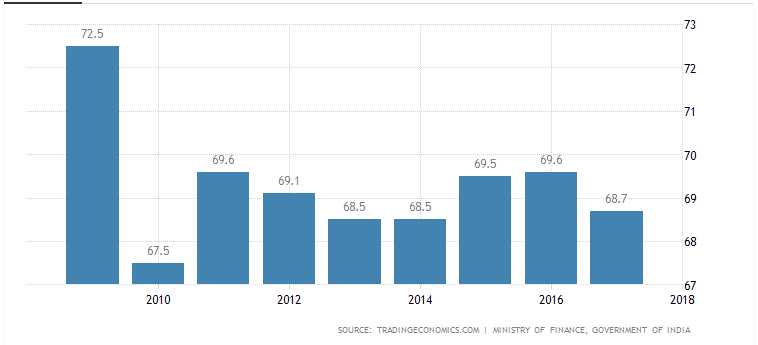
  • India’s debt problem isn’t new. It just keeps repeating itself. Time by time we see Indian corporates getting involved in some scam, end up in bankruptcy due to high interest rates or close down due to poor financial management. It’s not the problem of corporates alone. Government itself, is also responsible for the misfortunes of the debt market but when you look at it with a holistic view, it becomes even harder to put blame on anyone for the misfortunes of the debt market in India. India cannot develop itself unless it develops its debt market. Going by this, the ruling party is trying everything it can to develop banking and financial market in India. It has taken risk and delivered on those fronts. The government’s intention to provide banking to every unbanked citizen will help increase savings and capital formation in the country. One can even hardly dispute this claim, “the number of people with bank accounts grew from 53% in 2014 to 80% in 2017 — it is not enough. As many as 191 million Indians over the age of 15, are still without a bank account. The figure places the country next only to China where roughly 224 million Chinese above the age of 15 do not have a bank account.”quoting the Times of India. The jump in the number of bank accounts and when comparing it to China, we can see how serious the government has been to bring formal ways of finance to every citizen. This progress is great but not enough. India is stuck in a classic problem. Maximum Indians don’t earn enough income which can be saved so the marginal propensity to consume(for those who don’t know what this is- it means ratio of change in consumption to change in income) is quite high(est 0.7 according to Financial Express). Even after spending so much amount of income, they still don’t have a decent lifestyle. So whatever we earn, about 70% of it is used up in consumption. This leaves 30% of the income to be saved for capital formation.

    Let’s put things into perspective, India’s savings rate is declining, according to CEIC. It went from a high of 37.8% in 2008 to 30.5% in 2018. Meanwhile, Government is increasing its own spending. This year alone government expenditure is expected to rise by 8.87%, according to LIvemint. So the proportion of savings as a percentage of GDP being transferred to the government has increased. Now add the woes of the corporates in India. Many corporates like IL&FS, DHFL, Cox & Kings,etc have defaulted on their debt obligations. This has tarnished the image of the corporate debt in India. Crowidng out effect due to increased government spending and corporates themselves defaulting has created a drag on the economy for debt market. So what can be done?

    1.Use foreign debt

    Government has initiated foreign borrowing with this Budget. It has said it intends to borrow upto $10 billion dollars or close to 69,000 crore rupees(based on current exchange rate) to fund its expenditure. The problem with this kind of borrowing is the exchange rate. If a country employs foreign debt it can become as an added risk if the currency depreciates too much. India’s foreign exchange reserves and low interest rates globally currently provide some comfort to compensate for this added risk. This will free up upto 69,000 crores of savings in domestic economy for business lending. Also, it will reduce the interest rates in the economy. Internationally, we are seeing central banks cutting interest rates as economies are slowing down globally. The US Federal Reserve is expected to cut rates in its next meeting by 25bps. Reserve Bank of India is also going to cut rates going forward as economic growth slows down.

    Government debt to GDP ratio of India

    2. Privatise all banks

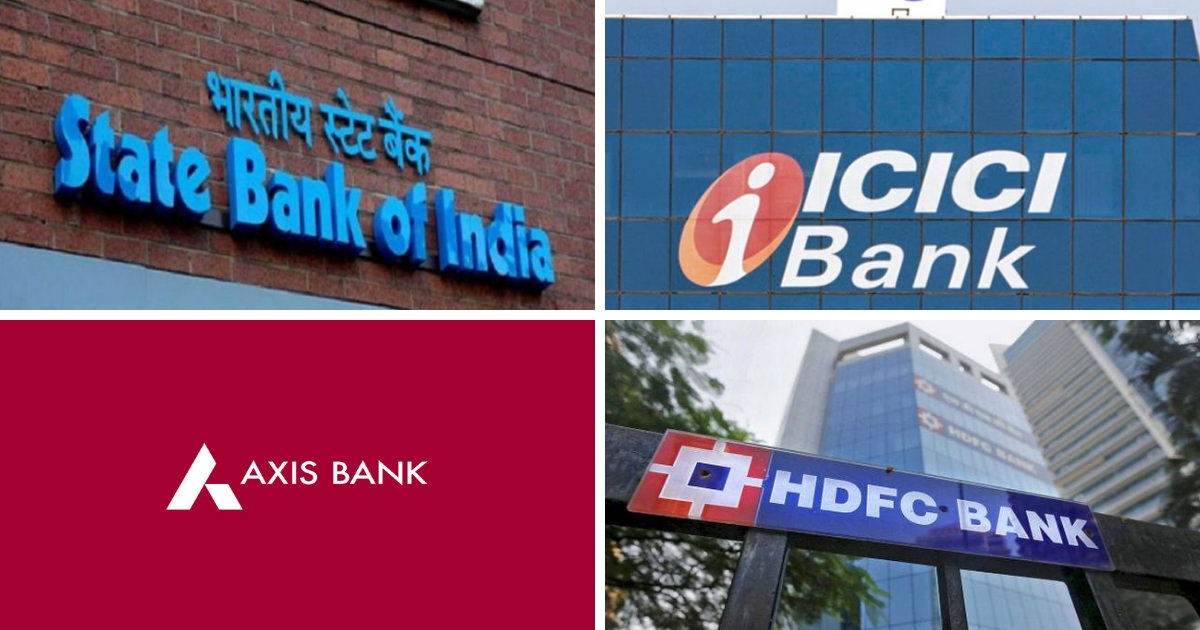
    Government of India can consider privatising all the PSBs of India. Each year, government has to engage in recapitlising the public sector banks and other failing PSUs which violate corporate governance norms or collude with the corrupt promoters and cause value destruction in the economy. These funds become an added cost to the economy which goes from taxpayers’ pockets. Major developed economies of the world except for China don’t interfere in banking and leave it for the private players. Privatising banks will help reduce NPAs(non-performing assets) as profit becomes their sole objective. This may become a hindrance to the development of rural India but we are seeing increased penetration of new age fintech NBFCs with great execution serving the unserved with financial services and delivering in rural India as well. Lately, lot of NBFCs engaged in rural markets are receiving funding from venture capitals to grow their operations. India’s disposable income is rising and there are way better private players with better technology than PSBs who can serve the rural market of India at cheaper costs. It has been a long time since PSBs were allocated to serve the Indian subcontinent but they have failed to reach their objectives. Gross NPAs stand at 9.0% currently for the whole banking industry and major chunk of it comes from the PSBs. Meanwhile, private sector is growing at a rapid pace and reporting considerably low NPAs as compared to PSBs. Plus, privatising PSBs will eliminate or help reduce sources for corrupt corporates unless they make their financial situation better.

    Credit: Google Images

    3. Structural improvements in the financial market

    Major improvement is needed in the area of monitoring financial stability of the economy. The way IL&FS crisis has unfolded, it has brought into focus several shortcomings in the financial sector. Commercial paper market has dryed up for NBFCs which has caused slowdown of the economy. When banks were dealing with their NPAs, NBFCs were helping grow the economy. They were engaged in lending and took more risk than banks thus helping reach new customers. SEBI has introduced mechanism of default probabilty for credit rating agencies which means they will have to assign default probabilty on each debt paper. Additional reporting requirements for systematically important finance companies could help improve and monitor financial situation in the economy.

    Credit: Google Images

    Making financial market efficient and better is important because it will help reduce interest rates in the country. High interest rates are charged even for good companies. This reduces the room for capital accumulation and profit. Many projects have returns which are low and give a very small room for corporates to make money. Reducing interest rates will have multiplying effects as projects earlier considered risky due to low returns will become financially feasible. US operates at a rate of close to 1-4% on average(last 20 years). Projects with low margins become financially feasible meanwhile in India it varies considerably time to time, this reduces the room for companies and increases the risk of default.

  • Modern Monetary Theory is the economic thought which presents the idea that the state can print as much money as it wants. It promotes the idea that the state, which owns the currency, cannot default on it and essentially can buy as much goods and services as it wants. This means there are no constraints on the government for spending. They don’t need to issue any bonds or charge any taxes to raise the money that they need to spend. This means that the private sector and the households can keep their hard earned money with them which means people can now have more money than they had ever before and spend it unjudiciously.

    All of this sounds really rosy. Economics as a subject is based on the idea that the resources are scare in nature. If you suddenly take out the scare elment from the equation, people will become unwise in how they spend money. Scarcity is the root cause of all economic problems. People become wise and innovative when they have constraints. US, UK, Japan and other developed countries rely on debt to fund their current consumption. This puts a ceiling in how much you can spend. Let us take a normal household, any household is not much different from the government in terms of money matters, only the size and needs differ. If you want to buy a car(luxury need) which is way above your pay grade, you have to take up too much debt and that causes you to sacrifice somewhere else to compensate for the interest and principal payment to even out your receipts and expenses. However, MMT says that you don’t need to worry about that debt and you can go on buying whatever you want without sacrificing on your lifestyle. Imagine if a country goes on such a spending spree without collecting any taxes or issuing bonds, the money in the economy will multiply manifold and cause too much demand which can result into hyperinflation. Although, MMT argues it can issue bonds or charge taxes, it can cause wild fluctuations in the economy. Right now we are constrained by how much we can spend, which is again dictated by our borrowing capacity and income that we earn. We pay taxes out of our incomes which reduces our spending as we need to save for future as well. With MMT, you will be way better off at an individual level. You will earn more in real terms(in simple layman term, more goods and services for you).

    My analysis and views on MMT

    In my view, everything has a trade off. You want to get better at something? You need to shell out more time for it. You are constrained by your time. Same way current economics constraints you to put resources in projects which are meaningful and productive. Earth has a limited productive capacity, only innovation and scientific discoveries can cause the productive curve to move upwards. MMT’s only visible advantage appears to be that everyone will be better off. Government could spend freely which will create jobs for the unemployed. It will allow people to accumulate more wealth and spend more than required. More number of people will live in luxury than possible today. Financial crisis of 2008 was a result of free money due to very low interest rate offered by the Fed after the dotcom bubble. Even low level of regulations in financial markets were a reason for the crisis.

    Source: US Treasury

    Anyways, this free money created too much optimism and speculation in the economy and caused a recession at a level which had not been seen since the Great Depression in 1929. Same way, MMT will cause free money to flow into the economy and cause speculation. Asset prices, credit and inflation all of them will spike. Basic tools of investment like NPV, payback period, etc will lose their relevance. Balance sheets will inflate and government bailout could become a norm and risk will no longer matter. MMT could cause government to dole out unnecessary incentives to people who are not contributing much to the economy. Capitlism stands on the idea that the best survivies in the market. This will be a direct violation of the principles of welfare captialism. People only innovate when they feel there is a need to change, this need comes from the idea that something is not upto expectations or could be done in a better way. In MMT, it won’t matter if something can be done in a better way or not because you got infinite resources which is not true when it comes to physical real resources present in nature. Nations need to innovate to stay competitive. This competition causes human civilization to move forward. Wealth creation will become a problem because you have no interest rate to evaluate risk of a business and also the wealth you accumulate will lose its value way faster as more money will be present in the economy. Bad managment of companies could become a new normal. Exchange rates will fall as more money is available. Those supporting the idea of MMT have to understand money was created to make exchange of goods and services easier. It was created to store wealth. With MMT, money will lose its importance. It was not created to spend on unproductive ventures. What do you think about this theory? Leave your thoughts below in the comments.